
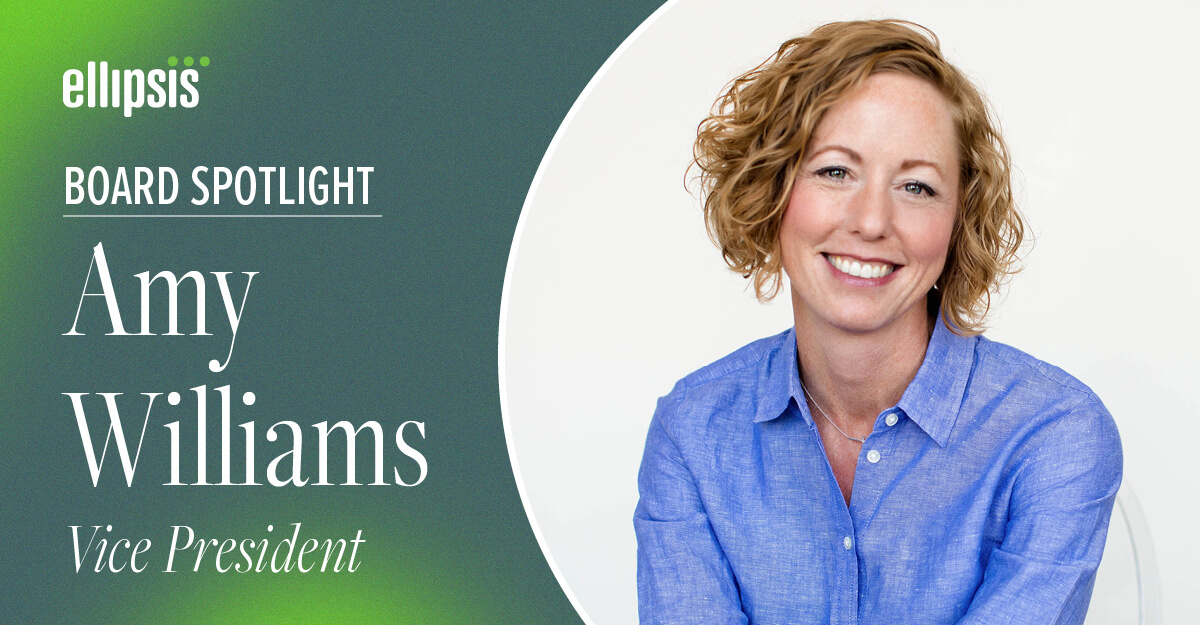
Amy Williams, a human resources consultant through her own firm, didn’t initially connect with Ellipsis through board service. Instead, she was introduced to it nearly a decade ago through her employer at the time, a corporate partner to one of its legacy organizations, Youth Emergency Services & Shelter (YESS). Her work in HR led her to get more involved as YESS — like many other nonprofits at the time — faced challenges with staff recruitment and retention.
“I had a skill set that was necessary at the time,” Amy said. “I came on in an advisory capacity to help work through potential new practices and implement a new retention strategy.”
What began as a way to apply her expertise to meet a specific organizational need quickly evolved into something more. Within a short period, she transitioned from an advisor to a member of the board of directors, eventually continuing her services through the merger that formed Ellipsis. Today, she brings nearly three decades of experience in HR and leadership to her role.
From Skill Set to Long-Term Commitment
While Amy’s initial involvement was rooted in professional expertise, it wasn’t what kept her engaged. Over time, her connection to the organization deepened as she experienced its mission and worked more closely with the people behind it.
“I really fell in love with the organization because of the people and its mission,” she said. “I'm using the term ‘organization’ because even though we had YESS and Youth Homes of Mid-America when I got involved, at the heart of it, their missions weren't that different.”
The continuum of care is also a defining strength of Ellipsis. Before the merger, youth were often moved between the two organizations to access different services.
“If we can provide stability, if we can provide continuity and maintain relationships in an already chaotic time for these kids and families, we’re on the right track,” Amy said. “With the continuum of care we offer, we can help prevent them from moving from one organization to another and then on to another to receive the care and support they need.”
A Strategic Perspective on Leadership
Now serving as vice president of Ellipsis’ board of directors, Amy brings a strategic lens to her leadership. “I know I came into this experience at first due to my expertise, but I pivoted away from that HR lens when I stepped into a board position,” she said. “Ellipsis has been very intentional in building out a board with a cross-functional representation of skills. I truly value that, and I think that makes us a really strong board.”
Amy also speaks to how her role on the board has evolved. “When there is a staff transition or we need to think about succession planning, sure, I can offer some professional guidance if they ask, but I would not necessarily say that is a singular lens,” she said. “I, as an executive on the board, think it's our job to provide Ellipsis leadership with the support they need and be a thought partner to them as they navigate all the normal challenges that face organizations and businesses today.”
She emphasizes the board’s role beyond governance. Advocacy, community engagement and visibility are all part of that responsibility. “It’s our role to promote the work that the organization is doing, from fundraising to advocacy to brand awareness.”
Adapting Through Innovation and Change
Over the course of her involvement, Amy has witnessed significant change within the organization — from leadership transitions to the merger that formed Ellipsis. She acknowledges that the work is not without complexity. “There is a lot of noise the organization has to navigate,” she said, referencing shifts in regulatory requirements, the direction of state funding and broader system pressures.
What stands out for her is how Ellipsis responds to the challenges. Amy points to a culture of innovation and a willingness to adapt as key strengths, particularly as leadership evaluates how to best meet the needs of kids and families in an ever-changing environment.
“I appreciate the willingness of the team and fellow board members to say, ‘let’s lay it all out and look at everything strategically to understand where we need to pivot and where we need to adapt,’” she said. “I think that’s a testament to why the organization and its predecessors have been a part of our community for so long.”
Measuring Impact in Lives Changed
For Amy, the impact isn’t defined by one milestone or initiative. It’s the data that resonates most, especially the number of kids and families served each year.
“When we get those numbers, it’s hard not to just sit there in awe,” she said. “Hundreds and hundreds of kids have been impacted by this organization. That’s what I’m really proud of.” Amy sees those numbers for what they represent: real kids and families from the same community where she and her family live. She and her husband have three kids, ages 11–23, so she understands what it takes to prepare young people for adulthood while balancing the demands of business ownership and community engagement.
As she and the board look ahead, she remains focused on supporting the organization’s continued strength and direction. She speaks with confidence in the leadership team and their ability to navigate both current challenges and future opportunities. “They are very diligent, astute and mature,” she said. “We are immensely grateful for them, and it helps us all move forward with strategic intention.”
Amy’s experience shows that community leadership can begin with a simple “I can help with that” mentality. She may not have started with a long-term vision for where it could take her, but choosing to stay engaged has led to a deep connection to the mission and a lasting commitment to the organization’s success.
Did you catch our Board Spotlight on Mick Lovell? Read it here: