
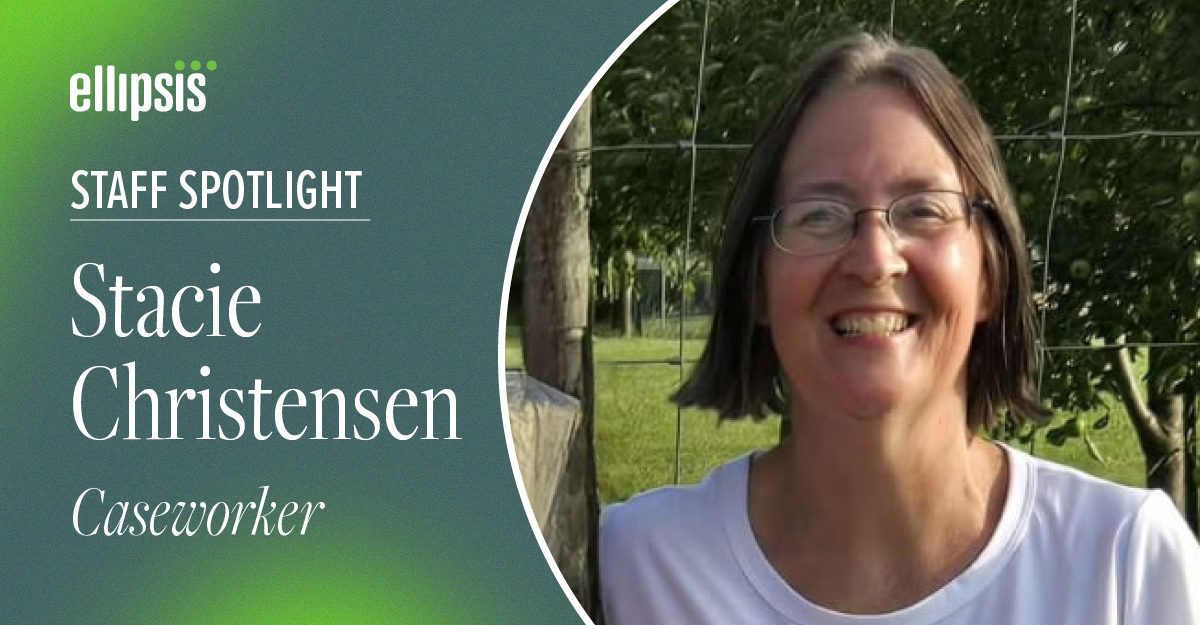
Meet Stacie Christensen, one of Ellipsis' longest-serving team members. She’s a caseworker who has dedicated 18 years to supporting youth in our community. Stacie has grown alongside the organization, witnessing firsthand the evolution of our services and the profound impact we have on families navigating challenging circumstances.
In this spotlight, she shares what drives her passion for this work and the unique perspective that comes from nearly two decades of service at Ellipsis and its legacy organizations.
What is your position with Ellipsis, and what does a typical day look like for you?
I am a caseworker for court-ordered females, so it’s a very specific group of our clients. My role is to coordinate care services for these girls. I'm the point person — and the liaison and the mediator — between placing officers, the child, families and the team. I focus a lot on supportive work with girls while they're here in a short-term capacity, and then I help transition them on. I spend a lot of time looking at what they need to be successful at their next placement and what their goals are when they leave the shelter.
How long have you worked here, and what initially drew you to Ellipsis?
Eighteen years. I've always been with the shelter side. I know it's going to sound crazy, but I've always loved the unpredictability. I like when each day brings something new, so you never really know what you might have to do.
Have you had any other roles at Ellipsis? How has your journey within the organization shaped your perspective on the need for the programs and services the organization provides?
I started out doing a paid internship as a supervisor at Youth Emergency Services & Shelter (YESS). I would be out supporting the staff, giving directions, scheduling, doing performance evaluations — those things. It was a paid internship, so that was a great starting point for me as a student. After I graduated, I joined the team as a caseworker.
I think this work has been pretty eye-opening for me. Sometimes when kids come in, their families have lacked the resources to fall back on. I have so much empathy for why they’re in our care, why they have experienced barriers. If we can put services in place and give parents the knowledge and resources to support their individual family — even though their child is out of their care and they know their kiddo is getting more than they could have given — we can help kind of make up that loss a little bit.
Please share a story about an experience that reaffirmed why you do this work. What made it so meaningful?
I was just sharing this story with our philanthropy department the other day. We had a client in Shelter who did not have a discharge plan and was without family involvement or support. While she was at Ellipsis, she wanted to go to the homecoming dance. She was all dressed up for homecoming, and her people — we even had a plan B — didn’t show up. I was on call, so they called me and said, "I know it's not what we typically do. People in my role at the organization don't typically take kids to extracurriculars, but can we get a staff member to take her to homecoming?” I'm like, “Absolutely — she has done everything to deserve it.”
When I followed up with her the next day, I asked her how she stays so positive and motivated when so many things put in front of her have been disappointments. She was like, “You know what, I always have Ellipsis to comfort me when I'm sad.” And I feel like that’s all we could ever do for this kid: show her that we were trying our hardest to help. She could see that, and she developed trust here.
What are some of the biggest challenges you face in this job, and how do you overcome them?
So when a kid comes in, we likely do not have much background information, health information, and zero consents and releases — and that's a detriment to the kiddo, and it’s no fault of theirs. We’ve just learned ways around some things, like when a diabetic kid gets pulled out of their home and they don't bring their insulin. That's life-threatening, and it’s on me to figure it out.
So, I think the challenges are learning what I can legally do within the realms of our contract and HIPAA to get the kid what they need for us to provide reasonable and prudent care. It’s challenging to not back down when somebody says they’re unable to give us what we need to provide that care.
What’s one thing you wish more people understood about the work you do?
This question is tough because how do you pick just one answer? For me, it’s understanding that we do have empathy for the kids and their families. Most, not all, of our clients are removed nonvoluntarily. They still love mom and dad, even though things are hard and they might not be safe. The parents often view us as judgmental or think we're not going to give them any input on care for their child. I wish people could remove the guilt and shame and just feel welcome at Ellipsis. We're here to assist, not to resist.
If you could describe your job in three words, what would they be and why?
- Unpredictable. Every day is different.
- Advocacy. We had a kid who was assigned to a therapist outside of Ellipsis who had a past with substance abuse and had some visible twitching and residual side effects. As a person who has been around substance abuse, the client recognized this and shared that this therapist might not be the best fit for her because being around her brought up some tough memories. I talked with the assignment team and asked for her to be switched. You have to listen to your clients, speak up for them and be assertive to have their needs met.
- Focused. You have to do all the small components of the overall job without losing focus on the main goal of the job: meeting the kids' needs. The other parts are secondary. We also need to focus on the small components because losing sight of those can impact other Ellipsis staff or people outside of our organization. We are all a team.
What’s one piece of advice you’d give to someone considering a career in youth services or mental health support?
Come in knowing your understanding of diagnoses and all of those things is not the same as experience. And when you see how different these kids are and how much more there is to them than a diagnosis or symptoms, it can sometimes cause people to lose their confidence. My advice is just don't give up. Unfortunately, the kids we work with do things that are viewed as awkward, uncomfortable or inappropriate, and we have to keep our heads so that we can give them a teaching moment and guide them the best we can.
But once you have successes and those experiences where a kid thanks you or a goal is reached at the end of something tough, then I think you're a lifer.
What’s one thing about Ellipsis that makes you most proud to be part of the team?
I can say without hesitation that anytime I've ever asked for anything for a client, I’ve never not had that need met. I think that is pretty amazing because I ask for a lot of things. It might not be exactly what I envisioned, but there are enough people engaged with Ellipsis that if our team can’t do it, they know someone who will fulfill the request for that kid. I'm not afraid to ask.
Outside of work, what’s something that brings you joy?
Rodeos. I often travel a couple hours each time to get to one, but I live in southwest Iowa, so there are a lot in my surrounding counties. I also love swimming. And I love to vacation, so if I'm not at work, I might just be in Mexico or anywhere warm. I'm not picky.