
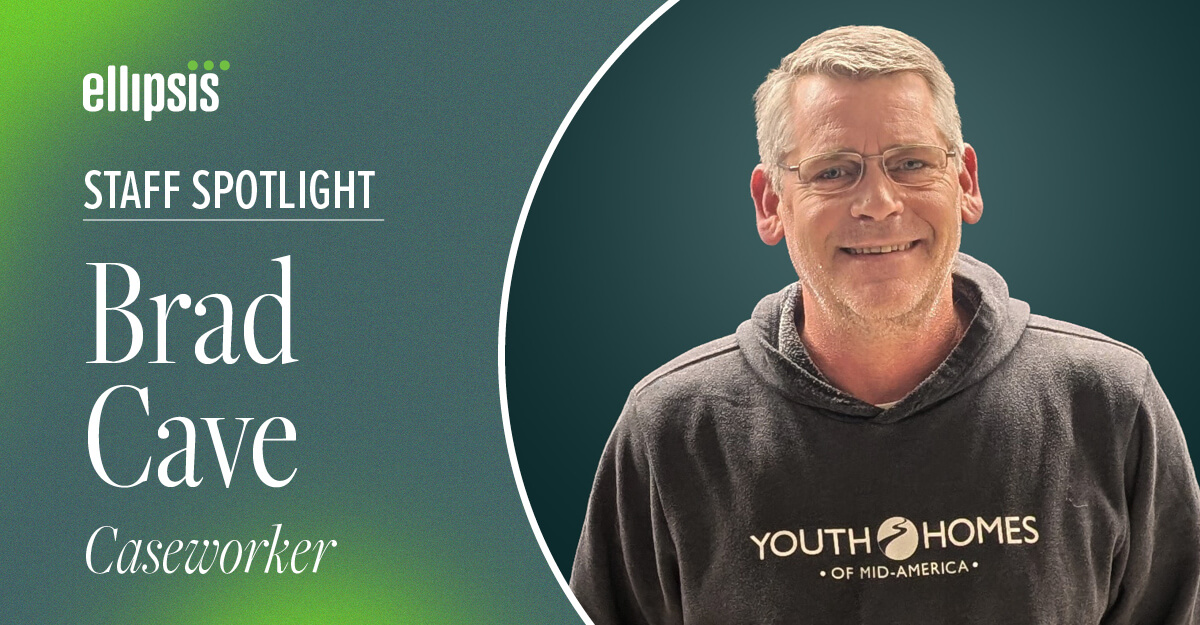
The impact of our work at Ellipsis is best understood through the people who show up every day to support youth navigating complex challenges. Caseworkers are often a steady presence in a young person’s life here, helping them access resources, build trusting relationships and take meaningful steps toward independence.
In this Staff Spotlight, Brad shares what the work really looks like for him, from the daily challenges to the moments that make his tenured career in youth services worthwhile.
What is your position with Ellipsis, and what does a typical day look like for you?
I’m a caseworker, and my day is usually split in two. About half of it is paperwork — emails, referrals, gathering information and tracking things down. A lot of times, there isn’t good continuity of care, so I’m trying to figure out things like who has the youth’s school records and how to get approval to access them to give them the help they need. That sometimes means I have to track down releases of information and coordinate with multiple systems.
The other half is spent meeting with kids. I have several in the Cluster and Scattered Supervised Apartment Living (SAL) programs, so I have a group here and then a few others who are spread out in the community. I meet with them weekly, wherever it makes sense for the youth. I could be going to their apartment, meeting them at McDonald’s or even sitting in my car in a parking lot. It really depends on what they’re most comfortable with.
Building trust is a big part of the job. It’s awkward for me to show up and say, “Hey, I’m here to help you figure out your life,” but it’s even more awkward for them. Many of these kids have been in the system for a long time and have had negative experiences, so earning their trust can be half the battle.
How long have you worked here, and what initially drew you to Ellipsis?
I’ve been with Ellipsis for 14 years. Before Ellipsis, I worked in social services for about 10 years doing community-based work with kids. I’ve always been drawn to this kind of work.
Have you had any other roles at Ellipsis? How has your journey shaped your perspective on the need for these services?
I started as a youth care worker and quickly moved into a counselor role at our Boys Qualified Residential Treatment Program (QRTP). When that role transitioned into casework, I stepped into that position. About five or six years ago, I started splitting my time between QRTP and SAL.
I’ve had the experience of working in both residential and independent living, which I think gives me a broader perspective. In independent living, there are different program options: Some youth live in one of our campus apartments with staff there to support them when they need it, while others live in the community in their own apartments or private homes.
Many of the youth in our independent living program have not had the best beginnings in life, and these programs try to help bridge those gaps by teaching the skills needed and helping them access services as they grow toward adulthood and independence. Getting a job, navigating the workplace, managing and budgeting money, planning for a career or college, and getting an apartment are big steps, and the youth need some guidance as they grow to adulthood. Going from learning basic living skills to living independently and responsibly on your own is a tough journey, and I’m glad we can be there to help them as much as we can.
Please share a story about an experience that reaffirmed why you do this work. What made it so meaningful?
This just happened recently. I was sitting in my truck waiting for a youth who was inside a convenience store when a man walked out and said, “Brad? Is that you?” He told me his name, and I realized he had been in one of our programs years ago.
I asked how old he was, and he said 29. He was excited to tell me about his job, his wife and his kids. Moments like that are incredibly rewarding. I’ve had similar experiences at places like the fair, where former clients come up, give me a hug and catch up.
Those are the moments that remind me why I do this work.
What are some of the biggest challenges you face in this job, and how do you overcome them?
One of the biggest challenges is connecting youth to the services they need and that are available to them. Many have moved frequently — different schools, therapists, families even — so there are a lot of moving pieces to put together.
Something as simple as enrolling a youth in school can be complicated. I’m not their parent or guardian, so I need to coordinate with the schools and maybe a parent who hasn’t been in the picture for a long time to get the proper documentation. Even getting a state ID can be a major hurdle. If a youth doesn’t have access to their Social Security card and the parent is unavailable, it becomes an even more complex process to navigate.
It’s really about taking things one step at a time, solving one problem and then moving on to the next. There can be a lot of starts and stops, like when a youth forgets login information to one of the service sites. It can be frustrating, but it’s all part of the experience and teaching them life skills.
What’s one thing you wish more people understood about the work you do?
Most of these kids aren’t bad kids. People hear “system kid” or “foster care” and assume something negative, but that’s not the reality. These are kids who have experienced difficult situations, limited support and a lot of change.
It’s hard for them to trust people and build relationships because the people who are supposed to teach them that haven’t been able to. Their reactions often come from those experiences — not from who they are as people.
If you could describe your job in three words, what would they be and why?
Compassion, relationships and tenacity. Those were actually the three values from when we were Youth Homes of Mid-America. They still apply today.
Compassion isn’t just feeling sorry for someone. It’s about understanding why they’re reacting the way they are and recognizing their situation isn’t often their fault. Relationships are really at the core of what we do. And tenacity is like what I was saying earlier: Things aren’t always easy when you think they should be, and sometimes you can’t get the youth something they need right away, but you always have to find another way. You can’t just give up in this job.
What’s one piece of advice you’d give to someone considering a career in youth services or mental health support?
It can be incredibly rewarding. Building relationships with youth, earning their trust and becoming a positive support in their life — that’s a great feeling.
You also have to not take things personally. Youth can say or do difficult things, especially when they’re frustrated or something isn’t working out for them the way they thought it would. Sometimes you become the person they blame, even when it’s not your fault. That can be tough. The impact you make can make it worth it.
What’s one thing about Ellipsis that makes you most proud to be part of the team?
Ellipsis is always willing to adapt. If a program needs to change, we change it. If something isn’t working, we figure out what we need to adjust. This work is constantly evolving based on the needs of the youth we serve, the research that comes out about care and development, and what services are available.
That flexibility is important because change is inevitable.
Outside of work, what’s something that brings you joy?
My family. I’m married, and we have three kids; two are grown. We have a couple of grandkids, and I like to spend a lot of time with them. If I were to say I had a hobby, it would be canoeing and kayaking. I’ve been on a lot of rivers, lakes and ponds. I’ll take my kayak just about anywhere.
Have you read any of our other Staff Spotlights? Find a collection throughout the Ellipsis Blog.