
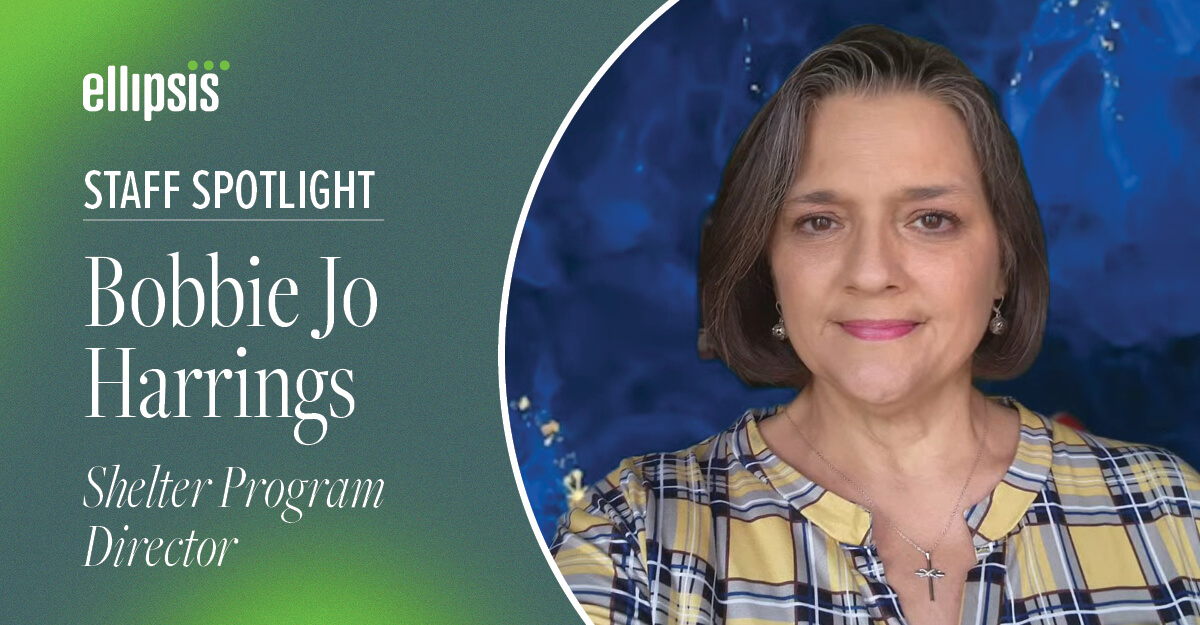
For Bobbie Jo Harrings, caring for young people is a calling that has shaped more than three decades of her life, especially her career.
Now, after seven years with Ellipsis, she is stepping into a new opportunity as shelter program director. Through every role she’s held within the organization, Bobbie Jo has remained grounded in a belief that challenging behaviors often point to something deeper and that patient, compassionate support can make a lasting difference — even when the impact is not immediately visible.
What is your position with Ellipsis, and what does a typical day look like for you?
I’m the newly appointed shelter program director. While I’ve been with Ellipsis for some time, I’m still in my first few weeks in this role. Right now, a typical day includes training, learning new processes, understanding the paperwork, and becoming familiar with the opportunities and responsibilities ahead of me.
How long have you worked here, and what initially drew you to Ellipsis?
I’ve worked here for seven years, but I have a long history — more than 30 years now — of involvement with foster care in some capacity. My husband and I began as treatment-level foster parents in Wisconsin, caring primarily for teenage mothers and their babies. We eventually had six children and adopted two children with specialized behavioral needs. We moved to Iowa about 25 years ago, and although we did not become licensed foster parents here, children still found their way into our lives.
At the time, I was working in revenue cycle management for hospitals. After our children grew up and left home, I told my husband I wanted to return to caring for children in foster care, but he was done. I thought, “If I can’t bring the kids to me, I’ll go to the kids.”
I saw an advertisement for a part-time youth care worker position with Youth Emergency Services & Shelter (YESS), which later became part of Ellipsis. I began working evenings while continuing my other career. After about two years, I was burned out from revenue cycle management and realized I wanted to return to caring for young people full time.
Around the time the organization became Ellipsis, I began working full time on the overnight shift. I later became the overnight supervisor, a position I held for about three years. When the shelter program director position became available, several people encouraged me to apply, and here I am.
Have you had any other roles at Ellipsis? How has your journey within the organization shaped your perspective on the need for the programs and services the organization provides?
Before becoming shelter program director, I had worked in nearly every role within the shelter outside of senior leadership and administrative positions.
I’ve been a youth care worker on morning, evening and overnight shifts. When the organization was still YESS, we also had a nursery that could care for as many as 12 children, and I worked there as well. I’ve filled in for Access and helped in many different areas whenever support was needed.
Working in so many positions has allowed me to see our programs and the young people we serve from many perspectives. Everything I have experienced has reinforced something I wish more people understood: The behaviors we see are often symptoms of a much deeper issue. We have to look beyond the behavior to understand what a young person has experienced.
There is a story, an adaptation of Loren Eiseley’s “The Star Thrower” that I often share when people ask why I continue doing this work. After a storm, thousands of starfish had washed onto a beach. A child began picking them up one at a time and returning them to the ocean. When someone pointed out that the child could not possibly save them all, the child picked up another starfish, returned it to the water and explained that he made a difference to that one.
That is why I do what I do. I may not be able to change everything, but I can make a difference for those who are here.
Please share a story about an experience that reaffirmed why you do this work. What made it so meaningful?
Early in our foster care experience, it could be frustrating to have children come in and out of our home without knowing whether we had made any difference in their lives.
Someone who had been doing the work much longer than we had once told us, “You have to trust and have faith in the process. You may never see the impact you make. You may never know how you changed a child’s life because you were only there for a short time.”
About 20 years ago, we temporarily cared for a 13-year-old girl whose placement was in danger of ending. She was angry, and I talked to her over and over again. At the time, I didn’t feel like I had made any difference. I wasn’t sure she had listened to a word I said. I eventually encouraged her foster family to give her another chance, and then our time together ended.
About 10 years later, my family experienced a devastating house fire and lost everything. She saw an article about the fire on Facebook and reached out.
She wrote the most heartfelt comment about how I had changed her life. She said she had arrived at our home as an angry girl who hated the world, but I helped her understand that she didn’t always have to be angry. By then, she was married and had two children of her own, and she thanked me for everything we had done for her.
I just cried. Just like I had been told: You may never know the impact you make on a young person’s life. That is why we do what we do at Ellipsis.
What are some of the biggest challenges you face in this job, and how do you overcome them?
One of my biggest challenges is getting close to these young people and then having to watch them leave.
I am very careful never to show favoritism, but the reality is that some people allow you to become closer to them than others do. It can be hard when they leave, especially when you are concerned about the situation they are returning to.
We have had young people who would rather remain in the shelter than return home. Some have sat in our Access area and refused to leave with their parents. I can’t describe the heartbreak of watching a child fight to stay in a shelter rather than go home. We have also experienced devastating outcomes after young people left our care, and those losses stay with you.
You don’t really get over those experiences. You move forward because you have to. You trust that you did the best you could during the time you had with that person, and you hope you gave them skills they can continue using to grow and heal. But I will never stop caring.
What’s one thing you wish more people understood about the work you do?
I wish more people understood that the behaviors they see or experience are symptoms of deeper issues. We need to look beyond the behavior to understand the root causes and treat those; otherwise, the behaviors will continue.
For these kids, they have to face experiences or emotions that have been pushed away for a long time, and that isn’t easy to do — and it’s often harder the more they avoid it. The behavior is not the whole child. It is a signal that something deeper needs care and attention.
If you could describe your job in three words, what would they be and why?
Rewarding because I have the opportunity to make a difference and am sometimes fortunate enough to see that difference.
Patient because this work requires patience. We have to let these kids be how they are now as they are work to discover who they are and who they want to be.
Fulfilling because I truly feel like this is what I am meant to do. Even in high school, my friends called me the mother of the group. I grew up with some experiences that were similar to what our young people at Ellipsis face, and I have always wanted children growing up in difficult circumstances to know that someone cares about them and that they are worth it.
What’s one piece of advice you’d give to someone considering a career in youth services or mental health support?
Never lose sight of why you are doing the work.
After a particularly difficult day, it can be easy to wonder, “Why am I even bothering?” You cannot let the bad days win. Keep coming back to your purpose and remember why you chose to serve young people in the first place.
You also have to understand that you, as a staff person, are not necessarily the person a kid is angry with. Sometimes, we are simply standing in for someone else or providing a safe place for that anger to come out.
What’s one thing about Ellipsis that makes you most proud to be part of the team?
We do what it takes to help every young person feel important.
I have watched our staff make incredible adjustments to care for youth with a wide range of needs and abilities. Team members come together, learn from one another and adapt their approach based on what each individual young person needs.
It is incredible to see our staff meet young people where they are rather than expecting young people to fit into one standard approach. We adjust our care to fit the child.
Outside of work, what’s something that brings you joy?
I have 16 grandchildren, so spending time with my family brings me a lot of joy. It seems like I have one, two or three grandchildren stopping by almost every weekend.
I also love crafts and anything that allows me to be creative. Over the years, I have done many crafts with youth at the shelter. I even taught myself how to do acrylic nails, and I enjoy doing the girls’ nails here. I don’t watch much television, so I also spend time reading.
Most of what brings me joy centers around family and creativity. I also recently returned to college to earn my degree in psychology. Even after all these years, I am still learning how I can better serve young people.
Have you read any of our other Staff Spotlights? Find a collection throughout the Ellipsis Blog.